
“Don’t speak to me in English at school.”
“I don’t want my friends to know that Mom is a foreigner.”
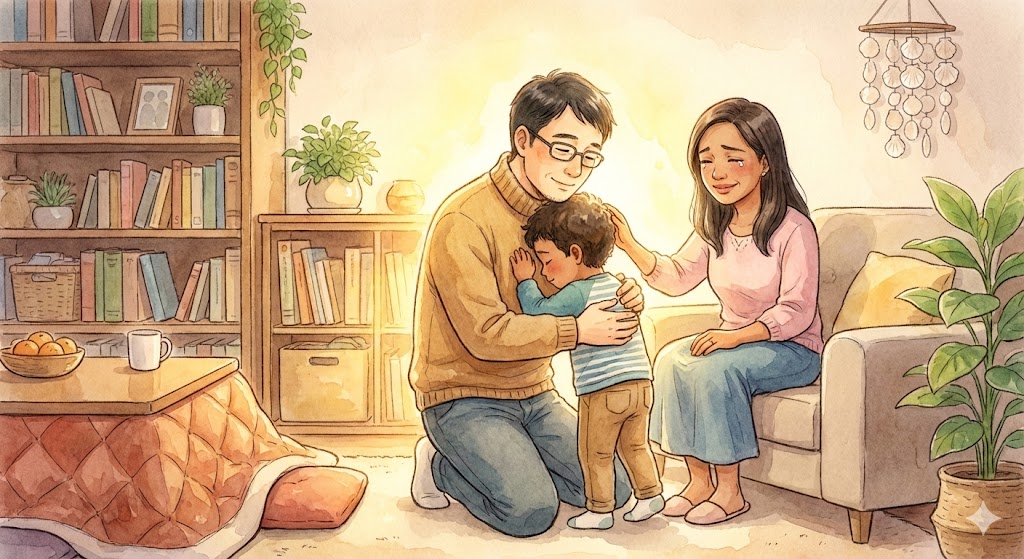
When our second-grade son said these words to us, we were shaken. “Is he denying his own roots?” “Was our love not enough?”
Furthermore, when my hurt wife says things like, “Sorry I am not Japanese mom,” as a father and a husband, I feel completely helpless.
However, a child feeling “ashamed of their parents” is actually proof that they are growing up well. It is a form of deep reliance—a kind of “amae”—that they can only show because they have absolute trust in their parents.
For an 8-year-old, school is a “Battlefield”
Why do they try to hide it? For an eight-year-old, a Japanese public elementary school is a “battlefield of peer pressure,” far more severe than adults might imagine. “Being the same as everyone else” is justice, and “being different” carries the risk of becoming a target for attack.
When they hide their English ability or avoid talking about their mother at school, it isn’t because they hate their parents. It is a highly intelligent “survival strategy”—a suit of “armor”—they have equipped to survive on that battlefield.
The Function of the “Secure Base” (Bowlby)
Here, there is an important concept I would like you to know. It is the idea of the “Secure Base,” proposed by British psychiatrist John Bowlby in his Attachment Theory.
Because children have a “Secure Base” (parents), they can venture out to explore the anxious outside world. If they get hurt, they return to the base to recharge their energy, and then go out again.
The problem arises when they return to that “Base” (home) hurt, only to be cornered with sound arguments like, “You should take pride in your roots,” or “It’s wrong to be ashamed.” If that happens, they lose the place where they can take off their heavy armor, and they become exhausted in both mind and body.
Helping them take off the “Armor” at home
The role of a parent as a “Secure Base” is not to educate. It is simply to accept.
“I see, it must be tough being asked so many questions at school.” “If you want to hide it, you can blame it all on Dad.”
I tell my son this: “Dad was selfish and insisted on marrying Mom.” “Dad is weird.” I tell him to blame everything on his father.
Giving him this weapon called “an excuse for the outside world” is the greatest protection I can offer him right now.
Not “I’m Sorry,” but “Welcome Home”
Of course, a mother never needs to apologize. For the mother to stand tall and smile, and for the father to take the heat as the “weird Dad”—this makes the home the strongest “Secure Base.”
Someday, he will surely grow up and take flight, using his roots as his wings. Until that time comes, let us remain steadfast and happily serve as our child’s “perfect excuse.”
We do this so that he can always come home from the battlefield with peace of mind, a place where he is allowed to whine and show his weakness. That is the greatest support we parents can give.
コメントを残す