
Developing a Child’s Thinking Power Below the Surface
“If I sit right next to him and help, he can do it. But he won’t try to do it on his own.” “He could do his Japanese schoolwork if I just made him do it, so why won’t he?”
I often hear these voices of anxiety and frustration from parents of children with international backgrounds. However, I dare say this: If the child is resistant, you do not need to force them.
Forced Learning Only leads to “Average” Results
From a psychological perspective, “forced learning” where the parent holds the reins is merely extrinsic motivation (doing it to avoid being scolded or to receive praise). This approach will only ever get a child to a “so-so level”—perhaps enough to get average scores on a test. Without intrinsic motivation—that inner drive of “I want to know”—we cannot nurture the kind of “breakthrough intelligence” needed to transcend borders and cultural barriers.
What Cummins’ “Iceberg Hypothesis” Teaches Us
“But if I don’t say anything, he really won’t study.” “He won’t develop any habits.” To resolve this anxiety, let’s look at the “Common Underlying Proficiency (CUP) model,” also known as the “Iceberg Hypothesis,” proposed by Jim Cummins, a linguist at the University of Toronto.
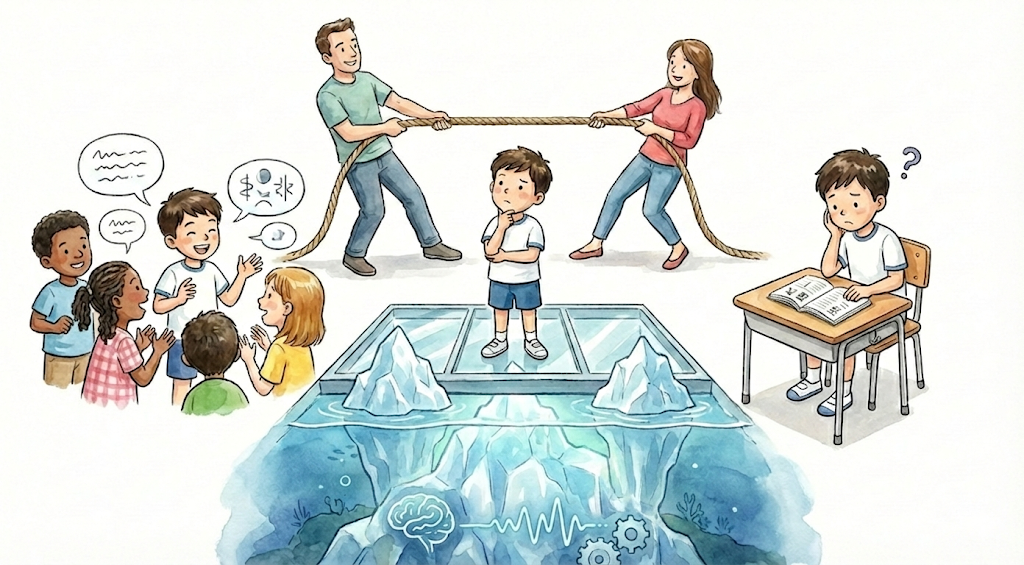
He explained that while two languages (e.g., Japanese and a native language) look like separate icebergs above the water, they are connected by a single, massive foundation (a tank of thinking) below the surface.
For many children with international roots, their “dominant language” (the language they think in) is often the language spoken by the parent at home. Even if your child dislikes school homework, if they are thinking deeply about things in their dominant language through family conversations and play, the iceberg below the surface (their thinking ability) is growing into something massive.
Their refusal to do Japanese homework is not laziness. It may be the stress of trying to express “highly developed thinking skills (bottom of the iceberg)” using an “immature output device (Japanese/top of the iceberg).”
Waiting for the “Transfer”
Cummins states that abilities developed in one language will “transfer” to the other. As long as the “power to think” is nurtured in the dominant language, that ability will flow into their Japanese as the child feels the need for it.
What parents should do is not destroy the parent-child relationship by forcing Japanese, but rather ensure they do not hinder the building of that “foundation of thinking” in the dominant language. It is simply a state where “the knowledge is already there, it just doesn’t have a Japanese label on it yet.” Eventually, the work of replacing English knowledge in the brain with Japanese (transfer) will occur.
When children get low scores on Japanese tests, we tend to think, “They don’t understand anything.” But the truth is, a child who can think in English already has a highly advanced concept (OS) installed in their head. They just can’t output the content using the “Japanese software” yet.
Therefore, rather than wearing down the parent-child relationship by fretting over immediate test scores, let us try to focus on watching how their “foundation of thinking (dominant language)” is being built.
コメントを残す